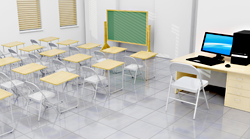
| Advice |
| 1. Organize the
desks so that they benefit your ability
to maintain control and efficiency. |
| 2. You decide
where a student sits. |
| 3. A good seating
chart will help you identify a student
by name from the first day. (Some
teachers like to seat students
alphabetically on the first day and
rearrange them later. This is a good
way of learning their names, it is up to
you and your comfort level). |
| 4.
Make sure that the seating is done in
such a way to avoid injury, especially
in a science lab setting. |
| 5.
Don't be afraid to move a student who is
disruptive or is not paying attention. |
| 6.
Change seats periodically to add variety
and minimize social interaction. |
| 7.
Once identified put disruptive students
near you so as to maintain control. |
| 8.
Leave adequate space for you and the
students to move around. |
| 9.
For safety reasons never put desks so
they block the exits. |
| 10.
During testing rearrange the desks so
that students cannot get answers to
questions. |
| 11. On the first
day put the student's name on their
assigned seats so they can find their
seats quickly. Let them know as they
enter to look for their names. |
| 12. Establish a
time out space for students who need to
sit away from the class until they
either cool off or agree to follow the
class rules. |
| 13. Establish a
procedure for students who have
gastro-intestinal problems so that they
will not distract the other students.
(call their parents and inform them of
the problem. |
| 14. Provide an
unrestricted view of the chalkboard and
your desk. |
| 15. Put your desk
somewhere you can see all the students
yet does not block the view of the black
board. |
| 16. If computers
are in your classroom, place them to
avoid glare from the windows or lighting
system. |
| 17. In computer
labs set up the monitors so you can view
the student's progress and assure that
they are not just surfing or playing
games. |
| 18. Arrange the
desks so that you can see if a
student is texting or twittering instead
of working. |
| 19. Provide an
off-limits space where the students know
not to be without your approval
or supervision. |
| 20. A cute
idea is to establish a cabinet near your
desk where student tests, papers,
reports etc are kept that have no names.
(I called it the Tomb of the Unknown
Student). If they don't get their paper,
test or report
back, they can check in
the file. |
| 21. Find out which
students have physical or emotional
situations that might require special
seating arrangements and respond
accordingly. |


 Classroom Seating: information
on the proper and efficient methods of seating in a
classroom. If seats are efficiently established the
students and the teacher can easily move around the
classroom, allow for the movement of air, prevent
cheating and socialization.
Classroom Seating: information
on the proper and efficient methods of seating in a
classroom. If seats are efficiently established the
students and the teacher can easily move around the
classroom, allow for the movement of air, prevent
cheating and socialization.