|
Seismic
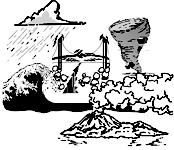
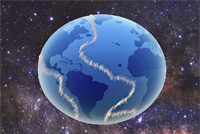
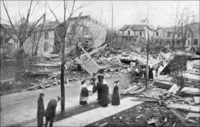
Earthquake: "An earthquake is the result
of a sudden release of energy in the
Earth's
crust
that creates
seismic waves.
Earthquakes are recorded with a
seismometer,
also known as a seismograph. The
moment magnitude
of an earthquake is conventionally reported, or
the related and mostly obsolete
Richter
magnitude, with magnitude 3 or lower earthquakes
being mostly
imperceptible
and magnitude 7 causing serious damage over
large areas. Intensity of shaking is measured on
the modified
Mercalli scale.
Source:
Wikipedia
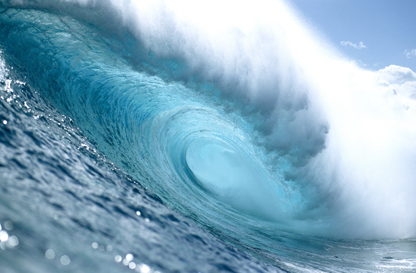
Tsunami: "A tsunami
(pronounced
/(t)suːˈnɑːmi/)
is a series of
waves
created when a body of water, such as an
ocean,
is rapidly displaced.
Earthquakes,
mass movements
above or below water, some
volcanic eruptions
and other
underwater explosions,
landslides,
underwater
earthquakes,
large
asteroid impacts
and detonation of
nuclear weapons
at sea all have the potential to generate a
tsunami. The effects of a tsunami can be
devastating due to the immense volumes of water
and energy involved. Since
meteorites
are small, they will not generate a tsunami."
Source:
Wikipedia
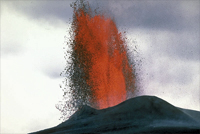
Volcanoes: "A
volcano is an opening, or rupture, in a planet's
surface or
crust,
which allows hot, molten rock, ash, and gases to
escape from below the surface. Volcanic activity
involving the
extrusion
of rock tends to form mountains or features like
mountains over a period of time.
Volcanoes are generally found where
tectonic plates
are
diverging
or
converging.
A
mid-oceanic ridge,
for example the
Mid-Atlantic Ridge,
has examples of volcanoes caused by "divergent
tectonic plates"
pulling apart; the
Pacific Ring of Fire
has examples of volcanoes caused by "convergent
tectonic plates"
coming together." Source:
Wikipedia |
|
Seismic Disaster Planning: Preventive
Measures Make a Difference
A plan for what personnel
will do in a disaster is based on a tree-model command ....
For further information, obtain a copy of Evaluation of
Seismic ... |
Seismic Network Could Improve
Disaster Response
Seismic Network Could
Improve Disaster Response. ScienceDaily (Feb. ... in
combination with other geodetic information, could be
applied to seismically ... |
Earthquakes
An
earthquake is the result of a sudden release of energy in
the
Earth's
crust that
creates
seismic waves.
Earthquakes are recorded with a
seismometer,
also known as a seismograph. The
moment magnitude
of an earthquake is conventionally reported, or the related
and mostly obsolete
Richter
magnitude, with magnitude 3 or lower earthquakes being
mostly imperceptible and magnitude 7 causing serious damage
over large areas. Intensity of shaking is measured on the
modified
Mercalli scale.
|
ABAG Earthquake Maps and
Information
A series of maps of the San
Francisco Bay Area showing many aspects of earthquake
effects. |
Earthquakes
General information on earthquakes |
Earthquakes for Kids
General information on
earthquakes |
Earthquake Hazards Program-USGA
Information on earthquakes from the US
Government |
Earthquake Information
The information included in
these documents is intended to improve earthquake
preparedness; however, it does not guarantee the safety of
an individual ... |
Earthquakes - IRIS
Earthquake information and
seismic data. ... National Earthquake Information Center,
World Data Center for Seismology, Denver, Colorado ... |
Earthquake-Wikipedia
Informational Site |
National Earthquake Information
Center - NEIC
Earthquake Hazards Program,
responsible for monitoring, reporting, and researching
earthquakes and earthquake hazards. |
Tsunami
A tsunami is a
series of ocean waves with very long
wavelengths
(typically hundreds of kilometres)
caused by large-scale disturbances of the ocean, such as:
earthquakes, landslides, volcanic eruptions, explosions &
meteorites Source:
Australian Bureau of Meteorology |
Bureau of Meteorology: Tsunami
Information
Information from the
Australian Bureau of Meteorology |
Earthquake Topics - Tsunamis
Information from the USGA |
Tsunami
The System evaluates
potentially tsunamigenic earthquakes and disseminates
tsunami warning information. The Pacific Tsunami Warning
Center (PTWC) is the ... |
Tsunami Websites
Links to websites that deal
with Tsunamis |
Welcome to Tsunami!
This website is dedicated to
providing general information about tsunamis, their causes
and history as well as what to do in case of a tsunami. ...
Tsunami-Wikipedia
Informational Site |
Volcanoes
A volcano is
an opening, or rupture, in a planet's surface or
crust,
which allows hot, molten rock, ash and gases to escape from
below the surface. Volcanic activity involving the
extrusion
of rock tends to form mountains or features like mountains
over a period of time. Source:
Wikipedia |
Volcanoes
Interactive site on the
workings of a volcano-Very well created and informative |
Facts about Volcanoes for Kids
What is a volcano? ... Why
do volcanoes erupt? ... Where do volcanoes erupt? ... How
hot is a volcano? Volcanoes in Space · Information on
Volcanoes ... |
Volcano, Volcanoes, Volcano
Information at LiveScience.com
LiveScience.com explains
volcano, volcanoes, volcano information, volcano world and
volcano eruptions. |
Volcanoes.com
For general
information about how volcanoes work, |
Volcano Information Center (VIC)
The purpose of the Volcano
Information Center (VIC) is to provide links to websites
that are resources for data not contained in VIC and to
inform the user ... |
Volcano World -
The Web's Premier Source of Volcano Info |
Volcanoes-Wikipedia
Informational Site |
|
Back To Top! |