Some graphics reproduced using Print Shop Deluxe, Broderbund
Software, Inc. All Rights Reserved used by permission. The Classroom does not claim
all descriptions of sites to be their own words.
The Classroom makes no promises or representations about the gadgets on
this site as to quality. content or performance
“American time has
stretched around the world. It has become the dominant tempo of modern
history, especially of the history of Europe.” Harold
Rosenberg
Modern History
Korean
War
(1950-1953)
"The
Korean War (Hangul:
한국전쟁;
Hanja:
韓國戰爭; 25 June
1950 – 27 July 1953[9][a])
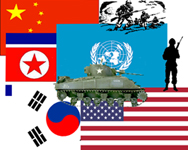
was a war between the
Republic of Korea (supported primarily by the
United States of America, with contributions from allied
nations under the aegis of the
United Nations) and the
Democratic People's Republic of Korea (supported by the
People's Republic of China, with military and material aid
from the
Union of Soviet Socialist Republics). The Korean War was
primarily the result of the political
division of Korea by an agreement of the victorious
Allies at the conclusion of the
Pacific War at the end of
World War II. The
Korean peninsula was
ruled by the Empire of Japan from 1910 until the end of
World War II. Following the
surrender of the Empire of Japan in September 1945, American
administrators divided the peninsula along the
38th parallel, with
U.S. military forces occupying the southern half and
Soviet military forces occupying the northern half. The
failure to hold free elections throughout the Korean Peninsula
in 1948 deepened the division between the two sides; the North
established a communist government, while the South established
a capitalist one. The 38th parallel increasingly became a
political border between the two Korean states. Although
reunification negotiations continued in the months preceding the
war, tension intensified. Cross-border skirmishes and raids at
the 38th Parallel persisted. The situation escalated into open
warfare when North Korean forces invaded South Korea on 25 June
1950. It was the first significant armed conflict of the
Cold War.[13]
In 1950 the
Soviet Union boycotted the
United Nations security council, in protest at
representation of China by the
Kuomintang /
Republic of China government, which had taken refuge in
Taiwan following defeat in the
Chinese Civil War. In the absence of a dissenting voice from
the Soviet Union, who could have vetoed it, USA and other
countries passed a security council resolution authorizing
military intervention in Korea.The United States of America
provided 88% of the 341,000 international soldiers which aided
South Korean forces in repelling the invasion, with twenty other
countries of the United Nation offering assistance."
Source:
Wikipedia
6.8 million American served,
200 American deaths (33,700 were actual battle deaths), 7,140 POW’s Source:
Veteransinfo
Aftermath: Korean
Demilitarized Zone,
|
Legacy of the Korean War
UNCMAC—the UN Command Military Armistice
Commission operating from 1953 to the present
UNTCOK—the 1950 United Nations Temporary
Commission on Korea
UNCURK—the 1951 UN Commission for the
Unification and Rehabilitation of Korea