HOME
Sponsorship
School Store
NET PRIMARY
Internet Lessons
PRIMARY SCHOOL
Main
Student's Corner
Teacher's Lounge
Parent's Corner
DEPARTMENTS
Art
English
Electives
ESL
Foreign Languages
Mathematics
Physical Education
ROTC
Science
Social Studies
Special Education
Teacher's Lounge
Parent's Corner 
RESOURCES
Colleges
Distance Learning
Expert Sites
Education Sites
Fun Room
Guidance
Homework Helpers
Home School
Lesson Plans
Library
Non-profits
Commercial Sites
Security 
Skills Center
School Evaluations
Tutors
Worksheets
Site problem 
Tell a Friend 
Submit a Link
Contact Us
Add To Favorites

Search this site or the web powered by FreeFind

Site search
Web search

Some graphics reproduced using Print Shop Deluxe, Broderbund Software, Inc. All Rights Reserved used by permission.
The Classroom does not claim all descriptions of sites to be their own words.

The Classroom  makes no promises or representations about the gadgets on this site as to quality. content or  performance

“When the power of love overcomes the love of power, the world will know peace.”
Jimi Hendrix

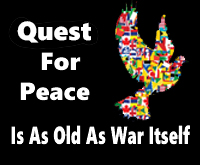
Peace

Peace"Peace is a state of harmony characterized by the lack of violent conflict. Commonly understood as the absence of hostility, peace also suggests the existence of healthy or newly healed interpersonal or international relationships, prosperity in matters of social or economic welfare, the establishment of equality, and a working political order that serves the true interests of all. In international relations, peacetime is not only the absence of war or conflict, but also the presence of cultural and economic understanding. From the Latin pax, meaning "freedom from civil disorder," the English word came into use in various personal greetings from c.1300 as a translation of the Hebrew shalom. Shalom, cognate with the Arabic "salaam", has multiple meanings: safety, welfare, prosperity, security, fortune, friendliness. The personalized meaning is reflected in a nonviolent lifestyle, which also describes a relationship between any people characterized by respect, justice and goodwill. This later understanding of peace can also pertain to an individual's sense of himself or herself, as to be "at peace" with one's own mind attested in Europe from c.1200. The early English term is also used in the sense of "quiet", reflecting a calm, serene, and meditative approach to the family or group relationships that avoids quarreling and seeks tranquility — an absence of disturbance or agitation. In many languages the word for peace is also used a greeting or a farewell, for example the Hawaiian word aloha, as well as the Arabic word Salam. In English the word peace is used as a farewell, especially for the dead as in Rest In Peace RIP.
Source
Wikipedia


Wikipedia Gateway
Open Directory Gateway
Activism and Peace Work | Anti-Interventionism | Art and Music | Articles | Chats and Forums | Conferences | Disarmament@ | Ethics@ | Grant-Making Foundations@ | NATO Hegemonism@ | Peace Studies | Personal Pages | Policy Institutes | Nonviolence: Organizations | Violence and Abuse | Warfare and Conflict | Dispute Resolution and Arbitration | Buddhism: Lineages: Nichiren: Soka Gakkai: Peace Projects
Yahoo Directory Gateway
Conferences | Conflict Resolution | Education | Human Rights@ | Institutes | Journals | Migration and Ethnic Relations@ | Organizations | Peace and Nonviolence@ | Regional Conflicts@ | War Reporting@


Back To Top!