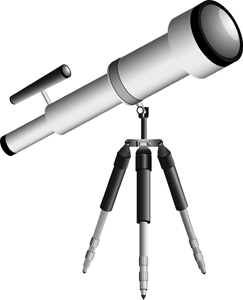
Astronomy: The scientific study
of the Galaxies, Stars, Nebulae, Solar Systems and the
Universe. It deals with a celestial objects
relationship to the Earth, size, position,
composition, motion, evolution and energy.
Astronomers use telescopes, satellites,
computers, space stations and observatories
to study the universe. Asteroid: A small to large
rocky celestial body that circles a star.
Comet: A celestial object with
ice at it's nucleus, when it approaches a star
it emits a tail of dust particles.
Meteor: A small celestial material
that when it enters an atmosphere disintegrates
white it leaves a streak of light in the sky.
1. "Every
day, Earth is bombarded with more than 100 tons
of dust and sand-sized particles."
NASA
click here for more facts.
2. "About
once a year, an automobile-sized asteroid hits
Earth's atmosphere, creates an impressive
fireball, and burns up before reaching the
surface."
NASA
click here for more facts.
3.
"Every
2,000 years or so, a meteoroid the size of a
football field hits Earth and causes significant
damage to the area.''
NASA
click here for more facts.
4.
"Only
once every few million years, an object large
enough to threaten Earth's civilization comes
along. Impact craters on Earth, the moon and
other planetary bodies are evidence of these
occurrences.''
NASA
click here for more facts.
5.''If
a rocky meteoroid larger than 25 meters but
smaller than one kilometer ( a little more than
1/2 mile) were to hit Earth, it would likely
cause local damage to the impact area."NASA
click here for more facts.
6. ''The
largest asteroid is Ceres, which is 933
kilometers (580 miles) across."
Ask and Astronomer
click here for more facts
7. "Meteors
are the short, white trails across the sky that
we call "shooting stars."Ask
and Astronomer
click here for more facts
8. "Asteroids
and comets are considered remnants from the
giant cloud of gas and dust that condensed to
create the sun, planets, and moons some 4.5
billion years ago."National Geographic
click here for more facts
9. "There
are LOTS of comets out there. Scientist
so far have discovered about 4,000 comets,,
and evidence suggests there may be hundreds of
millions more -- perhaps trillions."
Huffington Post
click here for more facts.
10. "All
comets orbit the sun.''
Huffington Post
click here for more facts.
Some graphics reproduced using Print Shop Deluxe, Broderbund
Software, Inc. All Rights Reserved used by permission.
The Classroom does not claim
all descriptions of sites to be their own words.
The Classroom makes no promises or representations about the gadgets on
this site as to quality. content or performance