Some graphics reproduced using Print Shop
Deluxe, Broderbund Software, Inc. All Rights Reserved used by permission.
The Classroom does not claim all descriptions of sites
to be their own words.
The Classroom makes no promises or representations
about the gadgets on this site as to quality. content or performance
General
Test Taking Tips From The Classroom
The
method by which students are analyzed to judge the
performance and achievements of any student as an
individual or as a group. Educators often refer to
what psychologist call
psychometrics to
judge the accuracy of their results. Numbers are
assigned to characteristics such as performance,
achievement, traits, intelligence, aptitude,
attitudes and interest.
1.
Remember it is only a test. Your
world will not end, for failure is
part of the learning process. Learn
from the failures.
2. Get
enough sleep before the test. Don't
take stimulates, such as caffeine to
keep you awake.
3. Come
prepared! Bring pencils or a pen
(which ever is required), paper,
notes (if it is open notes),
textbook (if it is open book) and a
calculator (if it is allowed in a
math test).
4. Read the
directions carefully. Be sure you understand how the
test needs be done and how it will be graded. If you
don't understand something, ask the teacher to explain.
5. Read the test and answer
the familiar questions. Then return and work on the
unfamiliar questions.
6.Eliminate
any answers you know are absolutely wrong then
concentrate on the remaining.
7. If you don't understand a
question raise your hand and ask the teacher for
clarification.
8. Reread the test for any
errors, such as erasures or misinterpretations
9. When you get the test back check it for grading
errors. If you find one, mention it politely to your
teacher. Be prepared to justify what you found. You
might also want to correct your wrong answers.
10. Use the test as a learning
tool. Where did you go wrong? What wrong
assumptions did you make? Don't make the
same mistakes again.
Essay Tests:
Focus on the question.
Essay examinations can
be short answer questions or long general
questions. Essay tests do not have an exact
answer key. They are usually scored on the
logic and completeness of the answer,
although there will be certain facts
expected in the answer. The number one
reason students fail essay tests is because
they don't answer the questions completely
and specifically, and because their answers
are not well-organized, not because they
cannot write.
Source:
English Zone
1. Look at the key words such as "describe"
"compare and contrast" "explain" "outline"
"list" "discuss" each one requires different
answers and is graded differently.
2. Make a
thumb nail outline on the margins to
organize your thoughts.
3. Don't ramble or repeat
yourself. Stick to the point and don't be afraid to give
an answer.
4. Don't
be afraid to make a guess. You might just
get some points!
5. Make
your handwriting readable.
6. Watch for errors in grammar
and composition. They can be confusing!
A test in which students are presented with
a question or an incomplete sentence or
idea. The students are expected to choose
the correct or best answer/completion from a
menu of alternatives. Source:
Assessment Terminology
1. Answer
the questions you know are right and
eliminate them from the list.
2. Make an
educated guess with the remaining questions
and answers
3. Be
aware some teachers can use the same answers
more than once.
4. When
confused about a question ask the teacher
for a clarification.
Multiple Choice Four Part Answers :Think before answering
1. Answer
the questions you know are right first and eliminate them
from the list.
2. If you can not figure out
the correct answer, use B or C. Studies show that in
teacher made tests, 60% of the time either of these two
are likely the correct answer.
3. Many times the longest
answer is the correct one, since teachers often lift
statements from the book.
4. In a teacher made test, if two answers
are the exact opposite then one of the two
will probably be the correct answer.
5. In a teacher made test,
if one of the answers is unique or odd, it
stands a good chance of being wrong.
6. The answer is wrong when
you have a disagreement between the subject
in a question and a verb answer (example if
the subject is plural and an answer is
singular).
Multiple Choice Five Part Answers:
Not all answers are created equal!
6. When
you have a disagreement between the subject
in a question and a verb answer, then that
answer is wrong (example if subject is
plural and an answer is singular).
True False
Questions
Learn to
tell the difference from fact and fiction!
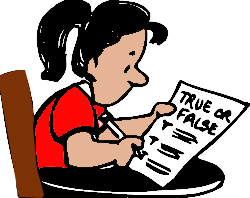
Definition: test in which statements
are to be marked either true or false.
Source: Answers.com
1. If
any part of a question is false then the
whole question is false.
2. If it doesn't make sense then it is
probably false.
3. When absolutes are used (always,
never, only etc.), then the question
is probably false.
4. When qualifying words such as
sometimes, possibly, may, etc., are
used then the question is often
true.
Fill in the Blank Questions
Don't be shy to answer!
Based on or being a test of reading
comprehension in which the test
taker is asked to supply words that
have been systematically deleted
from a text. Source: Answers.com
2.
Try inserting different words. If it
looks awkward try another.
3. Reread the sentence
and analyze it for awkward or
incomplete words.
Short Answers
A lot like the essay
questions except you are asked to
limit your answers to a brief
statement.
1.
Keep your answer concise and to the
point.
2.A note from experience. Your first answer is usually
the correct answer.
Remember that the above
should be used when you don't know the answer and are
not penalized for guessing!
Some
excerpted from Jan D. Kelly, "Be a Master Magician:
Taking Objective Examinations" in The Study Skills
Circus, Georgia State University, pp 80-88 Some excerpts from Thomas J. Baerwald and Celeste Fraser, "Good Study
Habits" Prentice Hall World Geography







 The
method by which students are analyzed to judge the
performance and achievements of any student as an
individual or as a group. Educators often refer to
what psychologist call
The
method by which students are analyzed to judge the
performance and achievements of any student as an
individual or as a group. Educators often refer to
what psychologist call