Some graphics reproduced using Print Shop Deluxe, Broderbund
Software, Inc. All Rights Reserved used by permission. The Classroom does not claim
all descriptions of sites to be their own words.
The Classroom makes no promises or representations about the gadgets on
this site as to quality. content or performance
"All warfare is based on
deception. Hence, when able to attack, we must seem unable; when using our
forces, we must seem inactive; when we are near, we must make the enemy believe
we are far away; when far away, we must make him believe we are near.” Sun Tzu
Resources
Definition: "A war is a conflict between two or
more groups that involve large numbers of
individuals. Wars may be prosecuted
simultaneously in one or more
theatres of war.
Within each theatre, there may be one or more
consecutive
military campaigns.
Individual actions of war within a specific
campaign are traditionally called
battles,
although this terminology is not always applied
to contentions in modernity involving aircraft,
missiles or bombs alone in the absence of ground
troops or naval forces."
Source:
Wikipidia
Chemical
warfare "Chemical warfare
is different from the use of
conventional weapons
or
nuclear weapons
because the destructive effects of chemical weapons are not
primarily due to any
explosive
force. The offensive use of living
organisms
(such as
anthrax)
is considered
biological warfare
rather than chemical warfare; however, the use of nonliving
toxic products produced by living organisms (e.g.
toxins
such as
botulinum toxin,
ricin,
and
saxitoxin)
is considered chemical warfare under the provisions
of the
Chemical Weapons
Convention. Under this
Convention, any toxic chemical, regardless of its origin, is
considered a chemical weapon unless it is used for purposes that are
not prohibited (an important legal definition known as the
General Purpose Criterion)...:
Source:
Wikipedia
Chemical Warfare Emedicine Injury from chemical weapon agents, known
as CWAs, may result from industrial accidents, military stockpiling,
war, or a terrorist attack.
Chemical Weapons & Warfare Agents Find information about the
chemistry, history, dispersal, toxicity, countermeasures, and
disposal of chemical warfare agents.
MedlinePlus: Chemical Weapons Chemical Weapons. Also
called: Chemical warfare. A chemical weapon is a toxic substance
used to cause injury or death. It can be a solid, a liquid or a gas.
...
Effects
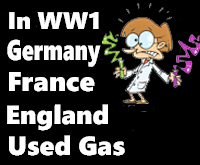
Chemical warfare can cause severe psychological,
physical injury and death. It was first developed during the first
world war and took millions of both military and civilian lives. It
was used most recently in Iraq during the Iranian Iraqi war.
Chemical Weapons
and Warfare Agents Strictly speaking, a
chemical weapon relies on the physiological
effects of a
chemical, so agents used to produce smoke or flame,
as herbicides, ...
Regular review:
Chemical weapons The psychological impact of
chemical weapons on society makes them ideal for .... Many of the
effects of chemical agents overlap with those of
common
.
Neuroscience for Kids - Nerve Agents
Chemical Weapons:
Nerve Agents ....
Effect of Atropine on the Transmission of
Acetylcholine in the presence of a nerve agent. ACh = Acetylcholine ...