HOME
Sponsorship
School Store
NET PRIMARY
Internet Lessons
PRIMARY SCHOOL
Main
Student's Corner
Teacher's Lounge
Parent's Corner
DEPARTMENTS
English
Electives
ESL
Foreign Languages
Mathematics
Physical Education
ROTC
Science
Social Studies
Special Education.
Teacher's Lounge
Parent's Corner 
RESOURCES
Colleges
Distance Learning
Expert Sites
Education Sites
Fun Room
Guidance
Homework Helpers
Home School
Lesson Plans
Library
Non-profits
Commercial Sites
Security 
Skills Center
School Evaluations
Tutors
Worksheets
Site problem 
Tell a Friend 
Submit a Link
Contact Us
Add To Favorites

Search this site or the web powered by FreeFind

Site search
Web search

Some graphics reproduced using Print Shop Deluxe, Broderbund Software, Inc. All Rights Reserved used by permission.
The Classroom does not claim all descriptions of sites to be their own words.

The Classroom  makes no promises or representations about the gadgets on this site as to quality. content or  performance

"That government is best which governs the least, because its people discipline themselves."
Thomas Jefferson

Hot Button Issues

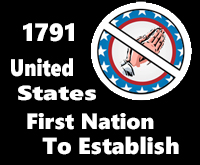
Separation of Church and State

Separation of church and state is a political and legal doctrine that government and religious institutions are to be kept separate and independent from each other. The term most often refers to the combination of two principles: secularity of government and freedom of religious exercise.
The modern concept often credited to the writings of English philosopher John Locke, the phrase separation of church and state is generally traced to the letter written by Thomas Jefferson in 1802 to the Danbury Baptists, in which he referred to the First Amendment to the United States Constitution as creating a "wall of separation" between church and state. The phrase was then quoted by the United States Supreme Court first in 1878, and then in a series of cases starting in 1948. This led to increased popular and political discussion of the concept. Source:
Wikipedia

Back To Top!