Some graphics reproduced using Print Shop Deluxe, Broderbund
Software, Inc. All Rights Reserved used by permission. The Classroom does not claim
all descriptions of sites to be their own words.
The Classroom makes no promises or representations about the gadgets on
this site as to quality. content or performance
"I don't know the key to success,
but the key to failure is trying to please everybody."
Bill Cosby
Down
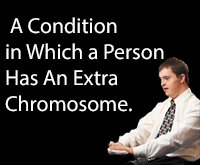
Syndrome "Down syndrome
or trisomy 21 (usually Down's Syndrome in British English[1])
is a
genetic disorder caused by the
presence of all or part of an extra
21st chromosome. It is named
after
John Langdon Down, the British
doctor who described it in
1866. The condition is
characterized by a combination of major and minor differences in body structure.
Often Down syndrome is associated with some impairment of
cognitive ability and
physical growth as well as
facial appearance. Down syndrome is usually identified at birth".
Source:
Wikipedi Famous people with Down Syndrome:
Stephane Ginnsz, (actor), Paula Sage
(actress and athlete), Judith Scott, (artist),
Karen Gaffney (swimmer,
activist, motivational speaker, President of
The Karen Gaffney Foundations).
Source:
Famous Down Syndrome People
Webpage Videos
Click on the little girl to view videos that deal
with Down Syndrome
Websites
"Individuals with Down syndrome
tend to have a lower than average cognitive ability,
often ranging from mild to moderate
developmental disabilities. A small number have
severe to profound mental disability. The
incidence of Down syndrome is estimated at 1 per 800
to 1,000 births, although these statistics are heavily
influenced by older mothers. Other factors may also play
a role." Source: Down syndrome - Wikipedia
Down Syndrome: Health Issues
by Len Leshin, M.D., F.A.A.P
Medical essays on Down Syndrome and issues common to children with Ds
Extensive listing of other Down Syndrome Websites
Family Village
A global community that integrates information,
resources, and communication opportunities on the Internet for persons with
mental retardation and other disabilities, their families, and those that
provide them services and supports.
"Trisomy 21 (47,XX,+21)
is caused by a
meiotic
nondisjunction event. With nondisjunction, a
gamete
(i.e., a sperm or egg cell) is produced with an extra copy of
chromosome 21; the gamete thus has 24 chromosomes. When combined
with a normal gamete from the other parent, the
embryo
now has 47 chromosomes, with three copies of chromosome 21. Trisomy
21 is the cause of approximately 95% of observed Down syndromes,
with 88% coming from nondisjunction in the maternal gamete and 8%
coming from nondisjunction in the paternal gamete."
"Karyotype
for Trisomy Down syndrome. Notice the three copies of chromosome 21"
To View Genetic
chart click on the image.
Source of information above and to the left:
Down syndrome - Wikipedia
Teaching
Strategies
"When
a child has trouble communicating or articulating, being
patient and modeling more appropriate interactions and
speech can be very telling. Providing aid upon request
(and waiting for the child to ask for the help rather
than assuming that he/she needs it) has also been
recommended. Giving the choice and the opportunity to
ask for assistance produces a sense of independence that
should be encouraged at all times"
Source:
Nahal DerayehDown Syndrome: Teaching Strategies
Teaching children with Down syndrome to read Abstract - This article describes the
development of our interest and expertise in the teaching of reading to children
with Down syndrome since 1980 and the
How to teach a child with
Down's Syndrome.
Down's syndrome in the classroom. ... Learning Disabilities
-
Teaching Strategies for Learning Disabled Students ...
Strategies for
teaching children with
Down syndrome are phonics based but also teach sight words
are multi-sensory will hold our son's interest and ...
Organizations
Associations that are designed to help the public
understand Down Syndrome.
Club NDSS
Resource site for people
with down syndrome and other developmental disabilities.
National Down Syndrome Society - Home
Not-for-profit organization supporting research
in the United States. Includes details of education and advocacy programs.
National Down Syndrome Congress
Creating a national
climate in which all persons will recognize and embrace
the value and dignity of persons with Down syndrome.