HOME
Sponsorship
School Store
NET PRIMARY
Internet Lessons
PRIMARY SCHOOL
Main
Student's Corner
Teacher's Lounge
Parent's Corner
DEPARTMENTS
English
Electives
ESL
Foreign Languages
Mathematics
Physical Education
ROTC
Science
Social Studies
Special Education.
Teacher's Lounge
Parent's Corner 
RESOURCES
Colleges
Distance Learning
Expert Sites
Education Sites
Fun Room
Guidance
Homework Helpers
Home School
Lesson Plans
Library
Non-profits
Commercial Sites
Security 
Skills Center
School Evaluations
Tutors
Worksheets
Site problem 
Tell a Friend 
Submit a Link
Contact Us
Add To Favorites

Search this site or the web powered by FreeFind

Site search
Web search

Some graphics reproduced using Print Shop Deluxe, Broderbund Software, Inc. All Rights Reserved used by permission.
The Classroom does not claim all descriptions of sites to be their own words.

The Classroom  makes no promises or representations about the gadgets on this site as to quality. content or  performance


Renaissance
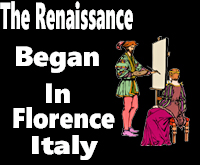
The Renaissance (from French Renaissance, meaning "rebirth"; Italian: Rinascimento, from re- "again" and nascere "be born") was a cultural movement that spanned roughly the 14th to the 17th century, beginning in Italy in the Late Middle Ages and later spreading to the rest of Europe. The term is also used more loosely to refer to the historic era, but since the changes of the Renaissance were not uniform across Europe, this is a general use of the term.
As a cultural movement, it encompassed a rebellion of learning based on classical sources, the development of linear perspective in painting, and gradual but widespread educational reform. Traditionally, this intellectual transformation has resulted in the Renaissance being viewed as a bridge between the Middle Ages and the Modern era. Although the Renaissance saw revolutions in many intellectual pursuits, as well as social and political upheaval, it is perhaps best known for its artistic developments and the contributions of such polymaths as Leonardo da Vinci and Michelangelo, who inspired the term "Renaissance man"
Source: Wikipedia
"At the end of the Middle ages northern Italy started a movement to bring back the classical art and thought of Greece and Rome. It comes from the French word that means rebirth. The movement quickly moved through out Europe in conjunction with the Enlightenment and the Scientific Revolution. The humanistic revival of classical art, architecture, literature, and learning that originated in Italy in the 14th century and later spread throughout Europe." Source: Answers.com
Websites
Before the Renaissance many believed that the Sun circled the Earth.
Renaissance - Wikipedia
Information Site
Renaissance 
Links to information on the Renaissance
Web Links - The Renaissance
Links to Renaissance Sites
The Idea of the Renaissance 
Background on the Renaissance
Renaissance: What Inspired This Age of Balance and Order? 
Informational Site
Renascence Editions: Works Printed in English, 1477-1799
Books of the period
A Renaissance timeline
Timeline of the Period

Civilization Past & Present - Illustrations  

This map illustrates Europe in the time of the Italian and Northern Renaissance

History of THE RENAISSANCE  

History of THE RENAISSANCE including The word Renaissance, Petrarch the Laureate, Petrarch, Boccaccio and humanism, Roman and italic
The Renaissance
Historians consider the Renaissance to be the beginning of modern history and the

History of the Renaissance in Europe: A rebirth, renewal, rediscovery  

A detailed history of the European Renaissance including its art, archetecture, scultures and writers.

Renaissance History Digital Library - Academic Info  

An annotated directory of the best Internet resources on the history of the Renaissance in Europe.

History of Medieval & Renaissance Europe: Primary Documents - EuroDocs  

Epact: Scientific Instruments of Medieval and Renaissance Europe. Access to images and descriptions from various history of science museums ...
Back To Top!