HOME
Sponsorship
School Store
NET PRIMARY
Internet Lessons
PRIMARY SCHOOL
Main
Student's Corner
Teacher's Lounge
Parent's Corner
DEPARTMENTS
English
Electives
ESL
Foreign Languages
Mathematics
Physical Education
ROTC
Science
Social Studies
Special Education.
Teacher's Lounge
Parent's Corner 
RESOURCES
Colleges
Distance Learning
Expert Sites
Education Sites
Fun Room
Guidance
Homework Helpers
Home School
Lesson Plans
Library
Non-profits
Commercial Sites
Security 
Skills Center
School Evaluations
Tutors
Worksheets
Site problem 
Tell a Friend 
Submit a Link
Contact Us
Add To Favorites

Search this site or the web powered by FreeFind

Site search
Web search

Some graphics reproduced using Print Shop Deluxe, Broderbund Software, Inc. All Rights Reserved used by permission.
The Classroom does not claim all descriptions of sites to be their own words.

The Classroom  makes no promises or representations about the gadgets on this site as to quality. content or  performance
 

"The moment the slave resolves that he will no longer be a slave, his fetters fall. Freedom and slavery are mental states.”
Gandhi
Slavery
 

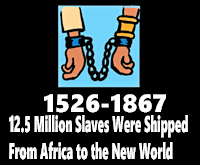
Soon after the first European settlers came to the New World they sought new sources of labor to work their farms. Indians proved to be a poor selection so they turned to the importation of slaves from Africa. The north had some slavery at first but its rocky soil and climate made it a poor place for this type of labor force. The south on the other hand proved to be a more suitable environment. With the advent of the tobacco and cotton crop more and more slaves were imported. Conditions were harsh since most slaves were considered property. Politically the purchase and ownership of slaves became stumbling block to maintaining our union and was not really resolved until the end of the Civil War. The free slaves still were mistreated and discriminated against after the war with a wave of segregation laws that did not end until the Civil Rights Act was passed.

Slavery "Slavery is a condition of control over a person against their will, enforced by violence or other forms of coercion. Slavery almost always occurs for the purpose of securing the labor of the person concerned. A specific form, known as chattel slavery, implies the legal ownership of a person or persons." Source: Wikipedia
Slavery in America The West African Squadron and slave trade
Report of Brown University Slavery and Justice Chronology on the History of Slavery and Racism 
Slavery - PBS 16 Largest Slaveholders from 1860 Census
African American - Homework Center Slavery Resource Guide...Library of Congress
Understanding Slavery Parliament & The British Slave Trade 1600 - 1807
Slavery, Abolition, and Emancipation  British documents.. slave holding and the slave trade
Images of African-American Slavery and Freedom The Story of Africa| BBC World Service
Chronology on the History of Slavery and Racism  History of slavery in the United States - Wikipedia
Abolitionists  
Abolitionists The Abolitionist
Abolitionism Abolitionists-InfoPlease
British Abolitionists Influence of  Abolitionists
The Underground Railroad-The Abolitionists  
Underground Railroad  
Aboard the Underground Railroad National Geographic
National Underground Freedom Center The Underground Railroad
Underground Railroad The Underground Railroad Map
The Underground Railroad-The Abolitionists Mapuse
Daily Life  
Daily Life of a Plantation Slave Life on North American Plantations
Life of a Slave (pdf) American Slave Narratives
Cyndi's List - African-American Life of a Slave
Uncle Tom's cabin Life as a Slave
Laws  
The Avalon Project: Fugitive Slave Law 1850 Fugitive Slave Laws
Laws Pertaining to Slavery Slaves and the Courts
Chronological Virginia Slave Laws, 1660s.
Slave Laws Relating to Speech and Assembly Virginia Law Servants & Slaves

Back To The Top!