Search this site or the web powered by FreeFind

Site search
Web search

Home
Parents
Secondary School
Primary School
Secondary Depts.
Primary Depts.
Secondary Teachers
Primary Teachers
Secondary Students
Primary Students
Secondary Subjects
Primary Subjects
Administration
Cafeteria
Transportation
Contact Us
Sponsorship


“Carpe diem! Rejoice while you are alive; enjoy the day; live life to the fullest; make the most of what you have. It is later than you think. Horace

Ancient Rome

North Africa

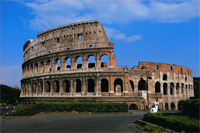
World History"Ancient Rome was a thriving civilization that grew on the Italian Peninsula as early as the 8th century BC. Located along the Mediterranean Sea and centered on the city of Rome, it expanded to become one of the largest empires in the ancient world. In its centuries of existence, Roman civilization shifted from a monarchy to an aristocratic republic to an increasingly autocratic empire. It came to dominate Southern Europe, Western Europe, Balkans, Asia Minor, North Africa and parts of Eastern Europe through conquest and assimilation. Rome was preponderant throughout the Mediterranean region, and was the sole superpower of Antiquity. Rome was the central power of Antiquity. The Romans are still remembered today, including such names as Julius Caesar, Cicero, and Horace. Roman culture and history has been praised by great thinkers and philosophers such as Machiavelli, Rousseau and Nietzsche. A society highly developed in military and political skills, Rome professionalized its military class and created a system of government called res publica, the inspiration for some modern republics such as the United States and France. By the end of the Republic, Rome had conquered the lands around the Mediterranean and beyond: its domain extended from the Atlantic to Judaea and from the mouth of the Rhine to North Africa. In the Empire, Rome entered in its golden times at the hands of Augustus Caesar. Under Trajan, the Empire reached its territorial peak. The republican values started to decline in the imperial times, and civil wars became the common ritual for a new emperor's rise. Plagued by internal instability and attacked by various migrating peoples, the western part of the empire broke up into independent kingdoms in the 5th century. This splintering is a landmark historians use to divide the ancient period of universal history from the medieval era ("Dark Ages" of Europe)." Source: Wikipedia


Carthage
Wikipedia Gateway
Carthage: History of Carthage | Carthaginian Republic | Punic Military Forces | Religion in Carthage | List of Kings of Carthage | Punic Wars  Hannibal | Umayyad conquest of North Africa | Phoenician languages | Carthaginian Republic
Libyans: Libya | North Africa during the Classical Period | Northwest Africa | History of North Africa | Berber people
Open Directory Gateway
Hannibal@ | Phoenicia


Some graphics reproduced using Print Shop Deluxe, Broderbund Software, Inc. All Rights Reserved used by permission. The Classroom does not claim all descriptions of sites to be their own words. The Classroom  makes no promises or representations about the gadgets on this site as to quality. content or  performance

Back To Top!